Wheat disease update – 16 March 2015

Wheat disease updates are written by Dr. Bob Hunger, OSU Extension Plant Pathologist

Oklahoma:  The leaf rust I saw around Stillwater in February seems to have “died out.”  The cold weather we had from late February into early March killed the lower leaves where leaf rust was active and conditions did not allow spread to younger leaves.  Dr. Brett Carver (OSU Wheat Breeder) confirmed this to me this morning as he indicated late last week he did not see any rust (leaf or stripe) around Stillwater or at his nurseries in Lahoma and Marshal.  This also is the case for northern and northwestern OK, as well as for KS (see Dr. De Wolf’s observations under “Other States” below).  Dr. Tom Royer and I visited variety trials at Cherokee and Alva last week.  No foliar diseases were observed but Dr. Royer did find a small greenbug colony on wheat in the field surrounding the Alva trial.  However, with mild temperatures and moisture predicted for the coming week and with inoculum to the south of us in Texas and southern Oklahoma, foliar diseases should be increasing in incidence and severity across central and northern OK.

Leaf and stripe rust are active in Texas (see Dr. Ron French’s observations below), and southern and central Oklahoma.  Mark Gregory (Area Extn Agron Spec – Duncan, OK) has reported seeing both leaf and stripe rust (but more stripe rust) across much of south-central and southwestern OK – especially around Grandfield, OK located north of Wichita Falls, TX.  Similar reports have come from Aaron Henson (Extn Educator; Tillman Cnty) and Gary Strickland (Exten Educator; Jackson Cnty).  Incidence has ranged from scattered to many “hot spots” of stripe rust, and from light to intermediate incidence of leaf rust.

Some of these fields (especially if it is a susceptible variety) will merit an early application of fungicide to curtail foliar disease activity (especially the stripe rust).  Be aware that applying a fungicide now will not last the entire season, and a second application toward head emergence also may be needed if weather continues to be favorable for foliar diseases.  For an early season application I recommend using a full rate (as opposed to a half rate) of a less expensive fungicide because there is so much time left in the growing season.  Then a later season application with a more expensive fungicide may or may not be needed.  Also be sure to not exceed the maximum amount of fungicide applied and to rotate chemistries to prevent resistance. Also consider your variety.  A variety like Ruby Lee that has good yield potential should be protected from early and late stripe or leaf rust, but a variety such as Duster may show some leaf rust early but still has good resistance to this rust.  However, stripe rust on Duster may merit control.  ALSO, in no-till fields watch for incidence of diseases such as tan spot, septoria, and powdery mildew as these diseases likely will be more common in fields with wheat residue and may merit an early season fungicide application.

Reports/excerpts of reports from other states:

Texas  Dr. Ron French (Ast Prof & Extn Plant Pathologist, Texas A&M AgriLife Extension Service, Amarillo) 9-Mar-2015:  “Last week, I was visiting the lower Coastal Bend of Texas (around Kingsville/Corpus Christi) and the Lower Rio Grande Valley of Texas (along the southernmost part of the Texas-Mexico border area). In Weslaco (Hidalgo County, Lower Rio Grande Valley), I visited sentinel plots (21 lines-winter wheat, spring wheat, barley…).”

“In Weslaco (March 4), Puccinia graminis f. sp. tritici, the causal agent of stem rust, was found on leaf tissue only, at trace levels to 1% severity in six 6 lines including  Morocco,  Marvelous, Kyto (CI 8250) and Line B (1% severity). Last year, stem rust was first observed on Siouxland, Panola, and  Morocco but observations were done the week of April 7, 2014.”

“Stripe rust (March 3)on wheat was observed  in 5 lines, ranging from  trace levels in Siouxland  to 25% incidence and 40% severity on Sisson.  Leaf rust was only observed at trace levels in lines such as Siouxland, Panola, and Sisson.  Powdery mildew was only present in the lower canopy of barley  Hypana, Morex DPH, and Hyproly.  Some wheat was already in the boot stage (Morocco, Line B).”

“Last year, dry conditions (little or no rain) were present in this area when stem rust was first observed. This year has seen more rain during the past three weeks, with temperatures ranging from as low as 38° F to as high as 84°F (lower on average for that area). With rain and warmer weather expected this week, disease pressure may be more conducive to seeing more disease development for all rusts.”

“No stem rust was observed in wheat in  the lower coastal bend around Kingsville, approximately 110 miles north of Weslaco. Fields did have stripe rust (up to 20% severity) but had already been sprayed with a fungicide and trace levels of leaf rust could also be observed.”

Kansas  Dr. Erick De Wolf (Prof & Small Grains Extn Pathologist, Kansas State Univ) 11-Mar-2015:  “We did some scouting for rust diseases near Manhattan (Northeastern KS).  We were checking on research plots where rust had been noted last fall but were unable to detect leaf rust in these plots so far this spring.  We noted severe tip die-back of the leaf tissue in these plots and suspect that this winter injury has removed much of the leaf rust from this location. Bethany Grabow, Ph.D candidate with KSU detected a trace of leaf rust on wheat in an adjacent field.  Incidence of disease was <0.01% with only a few pustules detected. This wheat was planted later than the aforementioned plots and did not experience the winter injury to the leaf tissue.  We also noted small colonies of aphids in the research plots with each colony having 3-5 aphids a few winged aphids were also observed near the colonies. We will continue to monitor the diseases this spring and provide more updates soon.”

Wheat leaf rust

Wheat leaf rust

Wheat stripe rust

Wheat stripe rust

First hollow stem update 03/12/15

First hollow stem is the optimal time to remove cattle from wheat pasture (full explanation). To monitor first hollow stem, we measure hollow stem for the 56 lines in our September-sown wheat forage plots at Stillwater each year. In spite of the recent cold snap many varieties are progressing towards first hollow stem. The small grains extension crew split ten stems from lines tested in our program today and Billings, Duster, Iba, Oakley CL, Hot Rod (formerly KS061406), WB Greenfield, and LCS Wizard join the list of varieties at or past first hollow stem. Full results are posted in the table below. Varieties with no value for first hollow stem reached first hollow stem on a previous measurement date.

We will take another set of measurements early next week and report the results on this blog. You can check progression of first hollow stem around the state by using the First Hollow Stem Advisor on the Oklahoma Mesonet site.


First hollow stem measured in wheat sown 09/16/2014 at Stillwater, OK. Varieties with ‘-‘ reached first hollow stem on a previous measurement date
Variety cm of hollow stem 03/12/15
Endurance 0.2
Deliver 1.0
Pete 0.6
OK Rising 1.1
Billings 1.6
Ruby Lee 0.9
Garrison 1.2
Duster 1.8
Gallagher
Iba 1.7
Centerfield 0.8
Doublestop CL Plus 1.4
NF 101
Everest
1863
KanMark
Oakley CL 2.0
Hot Rod 2.8
SY Llano
SY Southwind
Greer
Jackpot
SY Monument 1.2
SY Flint
SY Drifter
WB-Cedar
WB-Redhawk
WB4458
WB-Grainfield 2.0
Winterhawk
T153
T154
T158 0.9
LCS Mint
LCS Wizard 1.5
LCS Pistol
LCH13DH-20-87 2.6
LCH13DH-14-91
TAM 112
TAM 204
TAM 113
TAM 114
CO11D174
Byrd
Brawl CL Plus
OK09125 1.9
OK1059060-2C14 1.6
OK10126
OK11D25056 1.1
OK11231
OK12621 1.2
OK13625
OK0986130-7C13
OK08P707W-19C13 1.3
OK10728W
OK11755W


First hollow stem update 03/09/15

First hollow stem is the optimal time to remove cattle from wheat pasture (full explanation). To monitor first hollow stem, we measure hollow stem for the 56 lines in our September-sown wheat forage plots at Stillwater each year. In spite of the recent cold snap many varieties are progressing towards first hollow stem. The small grains extension crew split ten stems from lines tested in our program today and KanMark, Sy Southwind and Greer join the list of varieties at or past first hollow stem. Full results are posted in the table below. Varieties with no value for first hollow stem reached first hollow stem on a previous measurement date.

We will take another set of measurements later this week and report the results on this blog. Given the warm forecast for the coming week, I predict that all varieties will be well past first hollow stem by Friday. You can check progression of first hollow stem around the state by using the First Hollow Stem Advisor on the Oklahoma Mesonet site.


First hollow stem measured in wheat sown 09/16/2014 at Stillwater, OK. Varieties with ‘-‘ reached first hollow stem on a previous measurement date
Variety cm of hollow stem 03/09/15
Endurance 0.2
Deliver 0.2
Pete 0.3
OK Rising 0.7
Billings 1.0
Ruby Lee 0.6
Garrison 0.9
Duster 0.9
Gallagher
Iba 0.8
Centerfield 0.5
Doublestop CL Plus 0.6
NF 101
Everest
1863
KanMark 1.5
Oakley CL 0.9
KS061406 1.2
Sy Llano
Sy Southwind 2.6
Greer 2.1
Jackpot
Sy Monument 0.7
06BC722#25
AP09T7631 1.5
WB-Cedar
WB-Redhawk
WB4458
WB-Grainfield 0.8
Winterhawk
T153
T154
T158 0.8
LCS Mint
LCS Wizard 0.6
LCS Pistol
LCH13DH-20-87 1.0
LCH13DH-14-91
TAM 112
TAM 204
TAM 113
TAM 114
CO11D174 2.2
Byrd
Brawl CL Plus
OK09125 1.3
OK1059060-2C14 0.9
OK10126
OK11D25056 1.1
OK11231
OK12621 1.1
OK13625
OK0986130-7C13
OK08P707W-19C13 1.4
OK10728W
OK11755W


Army cutworms reported in some Oklahoma wheat fields

This article is provided by Dr. Tom A. Royer, OSU Extension Entomologist

Sug Farrington, Extension Educator in Cimarron County received a sample of “worms” that were collected by a producer in his wheat field. They turned out to be army cutworms.

Unlike the fall armyworm, this caterpillar overwinters in Oklahoma, tolerates cold and feeds throughout the winter months. Adult army cutworm moths migrate to Oklahoma each fall from their summer residence in the Rocky Mountains. They seek bare or sparsely vegetated fields (like a newly prepared field ready for wheat planting, or a field that was “dusted in” and had not yet emerged) and lay eggs from August through October. The eggs hatch soon after being deposited, which explains why a producer might see different sizes of larvae in a field. Army cutworms feed throughout the winter and molt seven times before they turn into pupae in the soil. Most larvae will be gone by late March and adult moths begin emerging in April and fly back to the Rocky Mountains to spend the summer.

Army cutworms. Photo courtesy Sug Farrington, Cimarron County Extension Educator.

Army cutworms can cause severe stand loss of wheat if not controlled. Cutworm damage often goes unnoticed through the winter because the caterpillars grow slowly and don’t get big enough to cause noticeable damage until temperatures warm in the spring. Unfortunately, that is also an indication of poor growing conditions due to drought (which cutworms also like), so it becomes important to check the fields for cutworms. If you notice a field at this time of year with a numbers of starlings or black birds feeding in a concentrated area of your wheat field, they are likely feasting on army cutworms!

Army cutworm injury in wheat. Photo courtesy Sug Farrington, Cimarron County Extension Educator.

Army cutworm injury in wheat. Photo courtesy Sug Farrington, Cimarron County Extension Educator.

Sample a field by stirring or digging the soil to a depth of two inches at 5 or more locations. Also, turn over those dried up cow patties, as they are a favorite hiding place for army cutworms. The cutworms will be “greenish grey”, and will probably curl up into a tight “C” when disturbed. A suggested treatment threshold is 2-3 caterpillars per foot of row when conditions are dry (like we are experiencing this winter) or 4-5 caterpillars per row-foot in fields with adequate moisture. Control suggestions are listed in Current Report-7194 Management of Insect and Mite Pests in Small Grains.

Army cutworms are also a potential pest of canola. Scout fields just as you would in wheat. The suggested treatment threshold for cutworms in canola is 1-2 per row-foot. Current recommendations for control of army cutworms in canola are listed in CR-7667, Management of Insect and Mite Pests in Canola.

First hollow stem update 03/05/15

First hollow stem is the optimal time to remove cattle from wheat pasture (full explanation). To monitor first hollow stem, we measure hollow stem for the 56 lines in our September-sown wheat forage plots at Stillwater each year. In spite of the recent cold snap many varieties are progressing towards first hollow stem. The small grains extension crew split ten stems from lines tested in our program today and1863, LCS Mint, TAM 204, TAM 113, TAM 114, and Byrd join the list of varieties at or past first hollow stem. Full results are posted in the table below. Varieties with no value for first hollow stem reached first hollow stem on a previous measurement date.

We will take another set of measurements later this week and report the results on this blog. Given the warm forecast for the coming week, I predict that all varieties will be well past first hollow stem by next Friday. You can check progression of first hollow stem around the state by using the First Hollow Stem Advisor on the Oklahoma Mesonet site.


First hollow stem measured in wheat sown 09/16/2014 at Stillwater, OK. Varieties with a “-” reached first hollow stem on a previous measurement date
Variety cm of hollow stem 03/05/15
Endurance 0.2
Deliver 0.2
Pete 0.1
OK Rising 0.2
Billings 0.7
Ruby Lee 0.6
Garrison 0.5
Duster 0.5
Gallagher
Iba 0.5
Centerfield 0.2
Doublestop CL Plus 0.3
NF 101
Everest
1863 1.6
KanMark 1.1
Oakley CL 0.6
KS061406 1.0
Sy Llano
Sy Southwind 0.9
Greer 1.1
Jackpot
Sy Monument 0.1
06BC722#25 2.8
AP09T7631 1.1
WB-Cedar
WB-Redhawk
WB4458
WB-Grainfield 0.8
Winterhawk
T153
T154
T158 1.3
LCS Mint 1.5
LCS Wizard 0.7
LCS Pistol
LCH13DH-20-87 1.1
LCH13DH-14-91
TAM 112
TAM 204 1.6
TAM 113 1.6
TAM 114 1.9
CO11D174 1.1
Byrd 1.7
Brawl CL Plus
OK09125 0.8
OK1059060-2C14 1.4
OK10126
OK11D25056 0.9
OK11231
OK12621 0.8
OK13625
OK0986130-7C13
OK08P707W-19C13 1.3
OK10728W 1.5
OK11755W
Average 1.0


First hollow stem update 03/02/15

First hollow stem is the optimal time to remove cattle from wheat pasture (full explanation). To monitor first hollow stem, we measure hollow stem for the 56 lines in our September-sown wheat forage plots at Stillwater each year. In spite of the recent cold snap many varieties are progressing towards first hollow stem. The small grains extension crew split ten stems from lines tested in our program today and NF 101 and Brawl CL Plus join the list of varieties at or past first hollow stem. Full results are posted in the table below. We will take another set of measurements later this week and report the results on this blog.

The numbers reported from Stillwater are likely behind those being observed in southern Oklahoma and ahead of those observed in northern Oklahoma. You can check progression of first hollow stem around the state by using the First Hollow Stem Advisor on the Oklahoma Mesonet site.


First hollow stem measured in wheat sown 09/16/2014 at Stillwater, OK.
Variety cm of hollow stem 03/02/15
Endurance 0.5
Deliver 0.4
Pete 0.1
OK Rising 0.1
Billings 0.4
Ruby Lee 0.2
Garrison 0.1
Duster 0.4
Gallagher .
Iba 0.1
Centerfield 0.1
Doublestop CL Plus 0.1
NF 101 1.5
Everest .
1863 0.6
KanMark 0.4
Oakley CL 0.6
KS061406 0.7
Sy Llano .
Sy Southwind 0.2
Greer 0.8
Jackpot .
Sy Monument 0.4
06BC722#25 1.3
AP09T7631 0.4
WB-Cedar .
WB-Redhawk .
WB4458 .
WB-Grainfield 1.1
Winterhawk .
T153 .
T154 .
T158 0.5
LCS Mint 0.8
LCS Wizard 0.9
LCS Pistol .
LCH13DH-20-87 0.8
LCH13DH-14-91 .
TAM 112 .
TAM 204 1.4
TAM 113 1.2
TAM 114 1.4
CO11D174 0.9
Byrd 0.7
Brawl CL Plus 1.8
OK09125 0.5
OK1059060-2C14 0.7
OK10126 .
OK11D25056 0.7
OK11231 2.2
OK12621 0.9
OK13625 .
OK0986130-7C13 .
OK08P707W-19C13 1.2
OK10728W 1.0
OK11755W .
Average 0.7


Wheat disease update – 27 February 2015

Wheat disease updates are written by Dr. Bob Hunger, OSU Extension Plant Pathologist

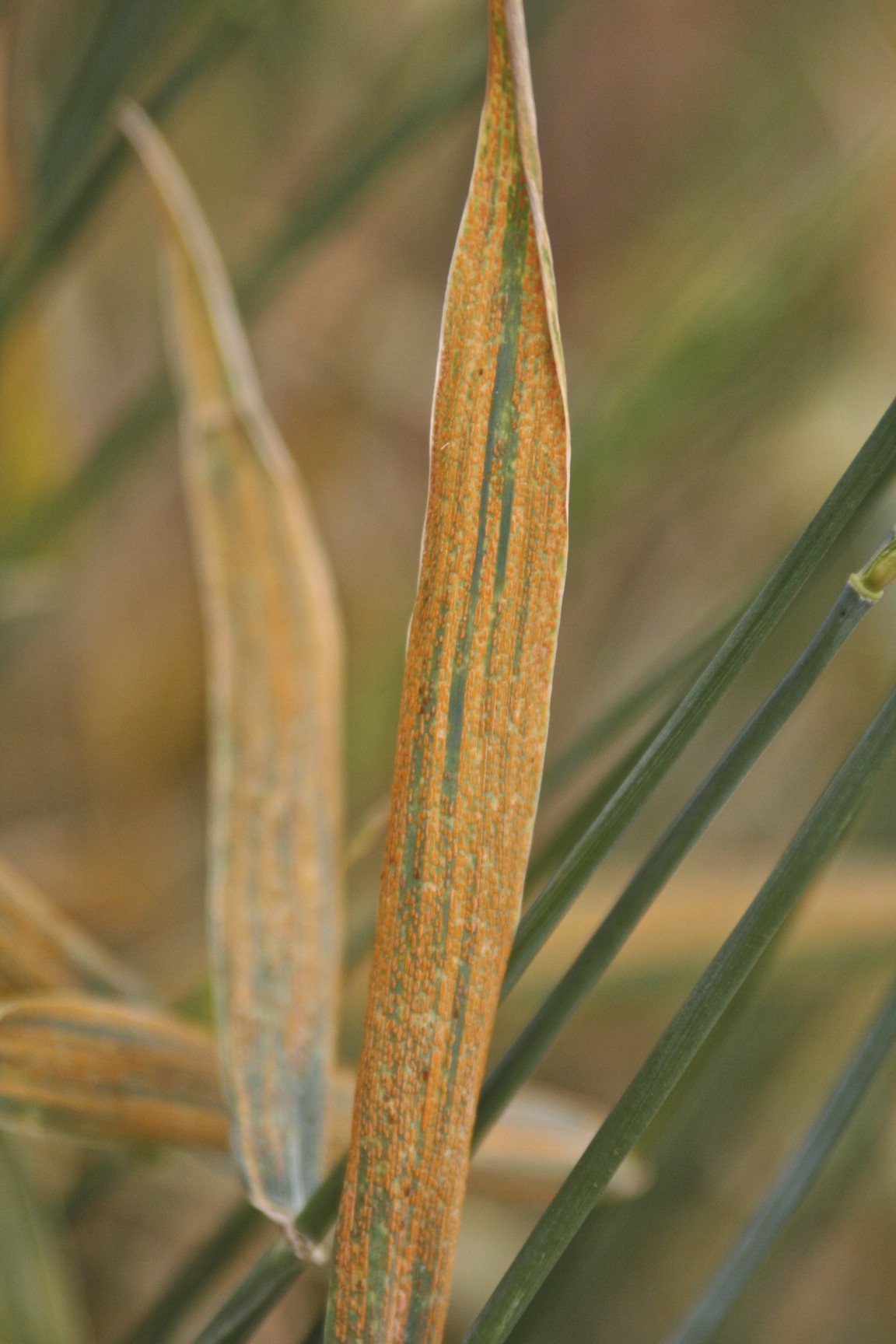
Oklahoma:  As indicated in the Texas reports below, both leaf rust and stripe rust are present across Texas with stripe rust appearing to be the most prevalent and severe.  This also seems to be the case in Oklahoma – at least across central to southern Oklahoma.  John Fenderson (Monsanto) indicated yesterday that on a recent trip he took across central to southern Oklahoma he saw “clean” wheat around Chickasha but along highway 70 going west to Frederick he saw lots of stripe rust and some leaf rust.  In a few places he saw the ground colored orange from stripe rust spores indicating a stripe rust “hot spot.”  In fields such as this (especially if there are many hot spots), application of a fungicide to control the stripe rust should be considered.  In addition to helping to control the stripe rust, there could be the benefit of also limiting leaf rust, powdery mildew and possibly tan spot/septoria.

Around Stillwater, I have not seen much change since two weeks ago.  I have not confirmed any stripe rust, but have seen leaf rust.  However, we have been mostly quite cold with only slight moisture but stripe rust may also be starting.  I will wait until it warms up a bit before I look again.

Wheat leaf rust

Wheat leaf rust

Wheat stripe rust

Wheat stripe rust

Reports/excerpts of reports from other states:

Texas 

Dr. Amir Ibrahim (Prof, Small Grains Breeding and Genetics, Texas A&M AgriLife Research) 26-Feb-2015:  The wheat crop in South Texas is at now at Feekes stages 5-6 [start of node elongation/first node detectable at base of tiller] depending on the line.   Leaf Rust (P. triticina) is spreading in our trials at College station (Brazos County) and both ‘Baldwin’ catch plot and ‘TAM 110’ are 100S.  As for stripe rust (P. striiformis), the ‘Sisson’ catch plot is 70S whereas the ‘Patton’ border is 100S.  It is noteworthy that we reported stripe rust on Patton near Ennis (Ellis County) on January 29, 2015.

Leaf rust is easy to find, but severity is very low at Bushland (Potter County) in Texas High Plains and Chillicothe (Hardeman County) in Texas Rolling Plains.  Unconfirmed reports also indicated spread of stripe rust in Brady (McCulloch County) in the heart of the state. Reports also indicated that ‘Redhawk’ was especially susceptible there and that some producers are already applying fungicides. Both leaf and stripe rusts are also present in Wharton County in South Texas.

If conditions continue to prevail, we can have significant leaf and stripe rust levels compared to last year, in my opinion.

Dr. Ron French (Ast Prof & Extn Plant Pathologist, Texas A&M AgriLife Extension Service, Amarillo) 25-Feb-2015:  Update on wheat rust in Texas- some commercial fields.  Leaf rust had been reported in Texas in fall 2014 as far north as Hansford County (Texas Panhandle, bordering the Oklahoma Panhandle) and throughout NW Texas, especially the Texas Panhandle. In early winter 2015, leaf rust was still found around the Amarillo area. This winter in Amarillo, we have had temperatures as low as 3°F  and will still be as low as 12°F and not much higher than the mid- 50s F for the next week, including snow.  In some cases when temperatures have dropped this much, some fields with trace levels of leaf rust no longer exhibited leaf rust for a while, whether that meant inoculum did not survive, was not active, or had new inoculum come in to that field. I visited some random fields today in the Amarillo area and was not able to find any leaf rust. This does not mean that leaf rust is not present but that it may be present at really low trace levels.

Last Wednesday, February 18, I did find leaf rust in one wheat field in Wichita County at trace levels in very few plants and only in the lowest two leaves. The biggest wheat in that field was at Feekes 4. Wichita County is in the Texas Rolling Plains and borders Clay, Wilbarger, and Archer Counties in Texas, and Tillman and Cotton Counties in SW Oklahoma. With high temperatures expected not to be higher than 63°F and as low as 25°F for the next seven days, could disappear, as observed in previous years when leaf rust was first observed in mid-to-late March.

Unlike 2014, no leaf rust has been observed so far in the lower Coastal Bend of Texas around Kingsville and Corpus Christi by this time. Some days have been cooler than normal and they have had more rain than in some previous years.

Stripe rust has been present as far west as Tom Green County in west Central Texas, where the city of San Angelo is located. Stripe rust was first observed at the very end of January and beginning of February. Stripe rust levels were significant in lower leaves only and the ground was covered in orange spores. A few fields that were sprayed with Tilt on February 16th had taken advantage of the fact that topdressing of nitrogen was being done on the wheat. Within a week, fields looked great and new growth looks “excellent” (probably a combination of topdressing, moisture from overhead pivot irrigation, root growth, and the fungicide application). At time of spraying, the wheat was fully tillered. Some varieties with some level of stripe rust include TAM 113, Coronado, Greer, Redhawk, Cedar, and TAM 304.

The farthest north I have seen stripe rust is in Wichita County at low trace levels, on February 18th.  The biggest wheat in that field was at Feekes 4. Although normally dry, this area may be getting some snow and rain in the next week or so, so there could be an increase in inoculum. But since temperatures are expected to range from 25° to 41°F on the low side, and between 32-63°F on the high side for the next seven days, this may not be conducive to stripe rust increase or establishment. Time will tell. Other fields in that area have not had stripe rust so far from what I gathered today.

Other locations with stripe rust include fields around De Leon, in Comanche County, located in Central Texas. The application Tilt in February is not uncommon in some locations in southern Texas as powdery mildew can be an issue. This year, applications of Tilt have occurred due to stripe rust concerns and in many cases, taking advantage of top dressing of nitrogen on wheat.

First hollow stem update 02/26/15

First hollow stem is the optimal time to remove cattle from wheat pasture (full explanation). To monitor first hollow stem, we measure hollow stem for the 56 lines in our September-sown wheat forage plots at Stillwater each year. In spite of the recent cold snap many varieties are progressing towards first hollow stem. The small grains extension crew split ten stems from lines tested in our program today and Gallagher, Everest, Jackpot, Winterhawk, T153, T154, LCS Pistol, and TAM 112 join the list of varieties at or past first hollow stem. Full results are posted in the table below. We will take another set of measurements the first of next week and report the results on this blog.

The numbers reported from Stillwater are likely behind those being observed in southern Oklahoma and ahead of those observed in northern Oklahoma. You can check progression of first hollow stem around the state by using the First Hollow Stem Advisor on the Oklahoma Mesonet site.

First hollow stem measured in wheat sown 09/16/2014 at Stillwater, OK. Varieties in red are at or past first hollow stem.
Variety cm of hollow stem 02/26/15
Endurance 0.0
Deliver 0.6
Pete 0.0
OK Rising 0.1
Billings 0.5
Ruby Lee 0.4
Garrison 0.1
Duster 0.1
Gallagher 2.0
Iba 0.1
Centerfield 0.2
Doublestop CL Plus 0.0
NF 101 1.0
Everest 1.6
1863 0.7
KanMark 1.1
Oakley CL 1.0
KS061406 0.8
Sy Llano
Sy Southwind 0.6
Greer 0.8
Jackpot 1.9
Sy Monument 0.0
06BC722#25 0.8
AP09T7631 0.1
WB-Cedar
WB-Redhawk
WB4458 1.7
WB-Grainfield 1.0
Winterhawk 1.9
T153 1.5
T154 2.3
T158 0.1
LCS Mint 1.4
LCS Wizard 0.7
LCS Pistol 1.7
LCH13DH-20-87 0.8
LCH13DH-14-91
TAM 112 1.9
TAM 204 1.3
TAM 113 1.4
TAM 114 1.2
CO11D174 1.1
Byrd 0.7
Brawl CL Plus 0.9
OK09125 0.9
OK1059060-2C14 0.9
OK10126 2.3
OK11D25056 1.5
OK11231 1.4
OK12621 0.6
OK13625
OK0986130-7C13
OK08P707W-19C13 1.0
OK10728W 1.0
OK11755W 2.2
Average 1.0


Plant growth regulators for wheat

Wheat lodging is not generally a widespread problem in Oklahoma, but it does occur. Lodging occurs due to a variety of factors, and as shown in the figure below, the timing of lodging will determine the final impact on grain yield. Lodging at head emergence, for example, can cause as little as 30 or as much as 80% yield reduction. The numbers in the figure do not account for harvest losses, which can exceed losses associated with lower photosynthetic capacity shown in the figure.

Slide05

Freeze injury or disease can cause lodging due to stem failure, which is characterized by plant stems breaking near the base. I the absence of weakened stems due to freeze or disease, most lodging in wheat is caused by failure of the root anchorage system (root lodging). Root lodging occurs when the anchorage system of a top-heavy wheat plant is weakened due to moist soil and wind provides sufficient force to overcome the rotational stiffness of the root/soil complex. Research has shown that increasing the soil water content from 17 to 26% reduced the force required for anchorage failure by 33%, and as little as 0.25 inches of water plus 11 mph winds were enough to cause lodging. The thicker the wheat crop and/or the taller the wheat crop, the more force that winds exert on the root anchorage system and the greater the likelihood of lodging.

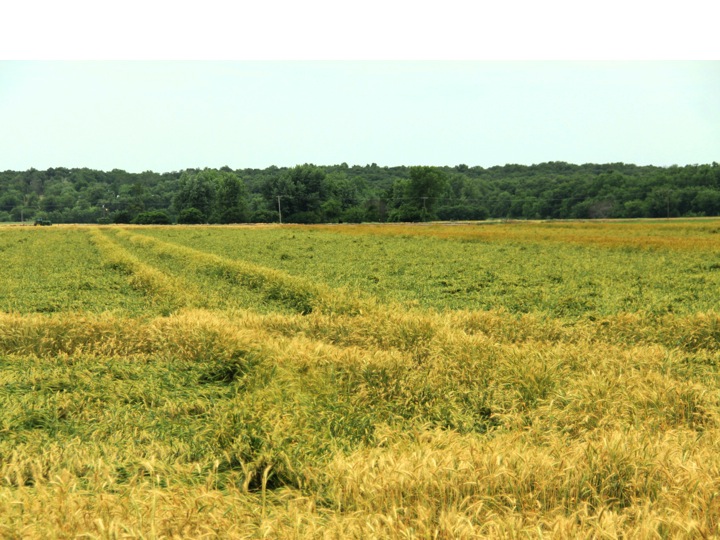
Severe lodging in an Oklahoma wheat field in 2013

In 2013 and 2014 we evaluated the plant growth regulator trinexapac-ethyl, which is sold under the trade name Palisade®. Palisade is a giberellic acid inhibitor and works primarily by reducing plant height. In our study we evaluated 12 oz/ac of Palisade with and without 4 oz/ac of Tilt (propiconazole) applied at Feekes GS 7 (two nodes visible above the soil surface). We included an untreated check and ALL plots, including the check, received 10.5 oz/ac of Quilt Xcel at Feekes GS 10.5 (heading). We conducted the trial at Stillwater (Irr), Perkins (Irr), and Chickasha (Non-Irr).


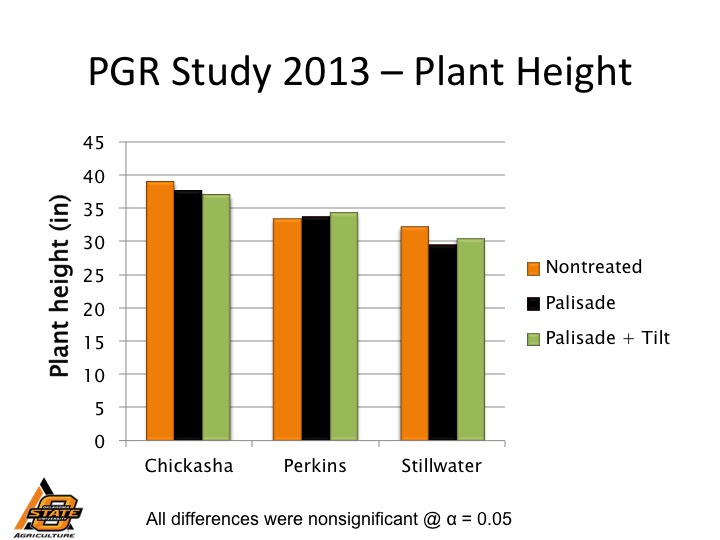
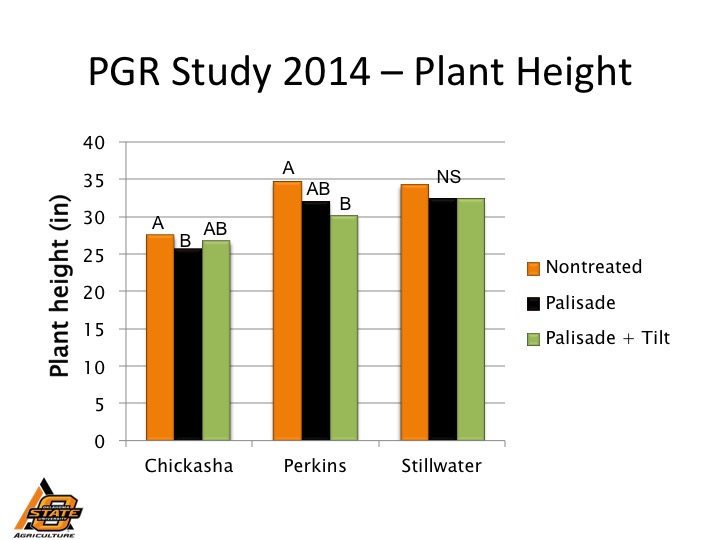
I provided 2013 results in a blog post last year, and this post provides an update including our 2014 findings. While application of Palisade resulted in numeric reductions in plant height at Chickasha and Stillwater in 2013, differences among treatments were not statistically significant. In 2014 application of Palisade or Palisade plus Tilt significantly reduced plant height at Chickasha and Perkins.

Wheat plant height as affected by plant growth regulators in 2013

Wheat plant height as affected by plant growth regulators in 2013


Wheat plant height as affected by plant growth regulator in 2014

Wheat plant height as affected by plant growth regulator in 2014

We rated plots for lodging at harvest using a 1 – 10 scale with 0 equaling no lodging and 10 equaling complete lodging.  Application of Palisade plus Tilt reduced lodging over Palisade alone at Chickasha. Application of Palidsade or Palisade plus Tilt resulted in numeric reductions in lodging scores at Stillwater in 2013, but the result were too variable to result in statistical significance. Palisade did not affect lodging at Perkins in 2013. There was no lodging for any site or treatment in 2014.


Lodging as affected by plant growth regulator in 2013. No lodging occurred in 2014 regardless of treatment.

Lodging as affected by plant growth regulator in 2013. No lodging occurred in 2014 regardless of treatment.


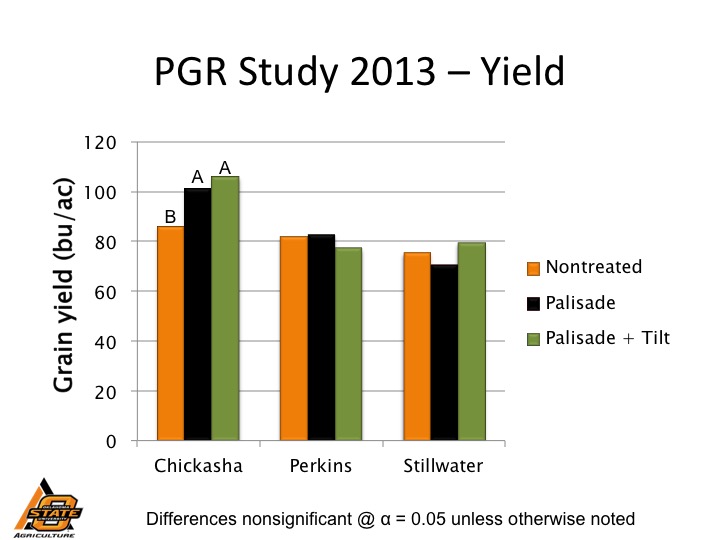
Application of Palisade or Palisade plus Tilt increased grain yield at Chickasha and had no effect on grain yield at Stillwater or Perkins in 2013. It is interesting to note that the Palisade treatment increased grain yield at Perkins in 2013 even though the plots lodged at comparable levels as the non treated check. My best hypothesis is that the treated plots lodged later than the non treated plots, as all plots were standing at anthesis (see picture below). Application of Palisade or Palisade plus Tilt increased grain yield at Perkins in 2014 even though there was no lodging. There were no differences in grain yield at Stillwater or Chickasha in 2014. Lodging occurred at Chickasha, but occurred later in the season.

Wheat grain yield as affected by plant growth regulator in 2013

Wheat grain yield as affected by plant growth regulator in 2013

Wheat grain yield as affected by plant growth regulator in 2014

Wheat grain yield as affected by plant growth regulator in 2014


To summarize our work, we found a trend for one to two inch reductions in plant height when Palisade or Palisade plus Tilt were applied, but this did not consistently translate to increased grain yield. Our results are consistent with other wheat plant growth regulator research, which has reported similar variation in response among sites and years.  The literature also shows that reduction in lodging is relative to the straw strength of the variety. That is, a plant growth regulator will not make a lodging prone variety stand like one with excellent straw strength, rather they will make it less prone to lodging relative to the same variety non treated.

Based on current evidence, plant growth regulators in Oklahoma are best kept on acres with high (> 80 bu/ac) yield potential that may have greater propensity for lodging due to variety or fertility.  If these high yield potential acres are being sprayed with a growth regulator at GS 7, the addition of a foliar fungicide might be prudent if it can be included at a relatively low cost. This early-season fungicide application will not, however, substitute for a fungicide application at flag leaf.

Full disclosure: Syngenta donated the product for this trial, but the only funding for the research was provided by the Oklahoma Agricultural Experiment Station and the Oklahoma Cooperative Extension Service. We conducted a separate trial evaluating Palisade in drought stress environments that was partially funded by Syngenta. The analysis and recommendations made in this blog post are based on research findings from 2013 and 2014 production years. Recommendations may change as further research is conducted and new information is obtained.

First hollow stem update 02/19/15

First hollow stem is the optimal time to remove cattle from wheat pasture (full explanation). We measure first hollow in our September-sown wheat forage plots at Stillwater each year, and the warm temperatures have caused first hollow stem to advance ahead of schedule this year. The small grains extension crew split ten stems from each of the 56 lines tested in our program yesterday and Sy Llano, WB-Cedar, WB-Redhawk, and a few experimental lines were all at first hollow stem. Early varieties such as Gallagher, Greer, Everest, WB4458, TAM 114, and Brawl CL Plus are not far behind. A full listing of first hollow stem measurements are included in the table at the end of this blog. We will take another set of measurements the first of next week and report the results on this blog.

The numbers reported from Stillwater are likely behind those being observed in southern Oklahoma and ahead of those observed in northern Oklahoma. Jim Johnson with the Noble Foundation reported seeing quite a bit of first hollow stem in early varieties last week.

Probability of first hollow stem for early maturing wheat varieties as estimated on 02/19/15. Red areas indicate there is at least 50% likelihood that early-maturing wheat varieties have reached first hollow stem in the shaded area.

Probability of first hollow stem for early maturing wheat varieties as estimated on 02/19/15. Red areas indicate there is at least 50% likelihood that early-maturing wheat varieties have reached first hollow stem in the shaded area.

One week projection of first hollow stem for early-maturing wheat cultivars 02/19/15

One week projection of first hollow stem for early-maturing wheat cultivars 02/19/15

The First Hollow Stem Advisor on the Oklahoma Mesonet indicates that  early varieties in southern Oklahoma are likely past first hollow stem and that early varieties in central Oklahoma will reach this point within a week.

Keep in mind the one week projection uses historical weather conditions which are slightly above our current forecast. Cooler than normal conditions will not last long and wheat can grow anytime average daily temperature is above 32F. So, my advice is to move cattle off of wheat pasture in southern Oklahoma yesterday, start moving them off of wheat pasture in central Oklahoma today, and move cattle off wheat pasture in northern Oklahoma next week.


First hollow stem measured in wheat sown 09/16/2014 at Stillwater, OK. Varieties at or past first hollow stem (>1.5 cm of hollow stem) are shaded in red.
Variety cm of hollow stem 02/18/14
Endurance 0.1
Deliver 0.0
Pete 0.0
OK Rising 0.0
Billings 0.7
Ruby Lee 0.0
Garrison 0.1
Duster 0.1
Gallagher 1.2
Iba 0.2
Centerfield 0.0
Doublestop CL Plus 0.0
NF 101 0.9
Everest 1.3
1863 0.6
KanMark 0.5
Oakley CL 1.0
KS061406 0.4
Sy Llano 2.7
Sy Southwind 0.8
Greer 1.4
Jackpot 0.8
Sy Monument 0.0
06BC722#25 0.5
AP09T7631 0.7
WB-Cedar 1.5
WB-Redhawk 1.5
WB4458 1.3
WB-Grainfield 0.1
Winterhawk 0.8
T153 1.1
T154 0.6
T158 0.1
LCS Mint 0.7
LCS Wizard 0.4
LCS Pistol 0.8
LCH13DH-20-87 0.4
LCH13DH-14-91 1.8
TAM 112 0.9
TAM 204 1.0
TAM 113 0.7
TAM 114 1.3
CO11D174 0.5
Byrd 0.5
Brawl CL Plus 1.2
OK09125 0.9
OK1059060-2C14 0.4
OK10126 0.5
OK11D25056 0.2
OK11231 0.6
OK12621 0.7
OK13625 1.6
OK0986130-7C13 2.2
OK08P707W-19C13 0.9
OK10728W 1.0
OK11755W 1.2
Average 0.7