2013-2014 Wheat fall forage variety trial results

This blog post is an abbreviated posting of our wheat forage results. For the complete report, consult OSU Current Report 2141 Fall forage production and date of first hollow stem in winter wheat varieties during the 2013-2014 crop year by clicking here.

Average daily temperature and rainfall for Stillwater, OK from 09/01/2013 to 03/31/2014

Average daily temperature and rainfall for Stillwater, OK from 09/01/2013 to 03/31/2014

Average daily temperature and rainfall for Chickasha, OK from 09/01/2013 to 03/31/2014

Average daily temperature and rainfall for Chickasha, OK from 09/01/2013 to 03/31/2014

As was the case across most of Oklahoma, our wheat plots were sown into dry topsoil in late September. Soils in southwest and northwest Oklahoma were extremely dry due to multiple years of drought, and wheat pasture was short in these areas of the state. Summer rainfall provided ample subsoil moisture in the central part of the state, but topsoil was largely dry through September. Rains fell across much of the state in October and provided the fuel needed to build wheat pasture. Unfortunately, these October rains would be the only significant rainfall events most of the Oklahoma wheat crop would receive .


Fall forage production by winter wheat at Stillwater and Chickasha averaged 3,240 and 2,580 pounds per acre, respectively (Tables below). There was a large group of varieties at Stillwater and Chickasha that produced statistically equivalent forage yield, and producers are encouraged to consider two and three year averages when available.


Table 2. Fall forage production by winter wheat varieties at Stillwater, OK during the 2013-2014 production year.
Source Variety  2013-2014  2-Year  3-Year
 —————lbs dry forage/acre—————-
Syngenta SY Llano 4,100
AGSECO TAM 113 4,090 3,160 3,220
OGI Billings 3,850 3,200 3,250
LCS LCS Mint 3,690
OGI Duster 3,670 3,180 3,300
OGI Gallagher 3,650 3,230 3,500
LCS T154 3,640 3,040
Syngenta Doans 3,610
WestBred WB4458 3,610 2,920
Syngenta Jackpot 3,600 3,060 3,150
WestBred WB-Cedar 3,560 3,240 3,250
OSU Deliver 3,470 2,770 3,010
WestBred Winterhawk 3,470 2,780 3,020
OGI Garrison 3,350 3,100 3,210
Watley TAM 112 3,230
OGI Doublestop CL Plus 3,200 3,020
OGI Pete 3,160 2,810 3,020
Syngenta CJ 3,130 2,810 2,980
LCS LCH08-80 3,120 2,950
WestBred Armour 3,110 3,000 3,100
LCS LCH11-1117 3,110
OGI Centerfield 3,090 2,820 3,120
OGI OK Bullet 3,090 2,630 2,820
Syngenta SY Southwind 3,090
OSU Endurance 3,080 3,080 3,310
KWA Everest 3,050 2,810 3,010
Syngenta Greer 3,040 2,840 2,960
LCS LCH11-1130 3,040
LCS T158 3,020 2,760 3,000
CWRF Brawl CL Plus 2,980 2,860
OGI Ruby Lee 2,980 2,610 2,900
LCS T153 2,960 2,840 3,090
OGI Iba 2,930 2,770 3,030
WestBred WB-Grainfield 2,910 2,920
WestBred WB-Redhawk 2,850 2,590
LCS LCH11-109 2,750 2,990
OGI OK Rising 2,720 2,720
CWRF Byrd 2,670 2,590
OSU Experimentals
OK09125 2,800 2,540
LSD (0.05) 750 500 400


Table 3. Fall forage production by winter wheat varieties at Chickasha, OK during the 2013-2014 production year.
Source Variety 2013-2014  2-Year
–lbs dry forage/acre–
OGI Duster 2,920 2,920
OGI Gallagher 2,920 3,010
LCS T158 2,900 2,580
CWRF Brawl CL Plus 2,830
KWA Everest 2,750 2,750
OGI Doublestop CL Plus 2,700
WestBred Winterhawk 2,680
LCS LCS Mint 2,660
OSU Endurance 2,630 2,620
WestBred WB-Cedar 2,590 2,630
CWRF Byrd 2,540
Syngenta Jackpot 2,540 2,460
WB-Grainfield WB-Grainfield 2,530
WestBred WB4458 2,520
OGI Iba 2,460 2,460
LCS LCH08-80 2,440
OGI Billings 2,420
OGI Ruby Lee 2,420 2,430
OSU Deliver 2,410 2,200
Syngenta Greer 2,380 2,480
Syngenta Doans 2,210
OGI Garrison 2,160 2,220
OSU Experimentals
OK09125 2,760
Average 2,580 2,560
LSD 430 290

First hollow stem data are reported in ‘day of year’ (day) format (table below). To provide reference, keep in mind that March 1 is day 60. Average occurrence of first hollow stem at Stillwater in 2014 was day 77. This was approximately five days later than 2013 and 25 days later than in 2012 and was the result of much cooler than normal temperatures. Unlike previous years, there was only about ten days difference among varieties in occurrence of first hollow stem.

Table 4. Occurrence of first hollow stem (day of year) for winter wheat varieties sown in 2013 and measured in 2014 at Stillwater, OK
Source Variety Stillwater
–day of year–
Syngenta SY Llano 72
WestBred WB-Cedar 72
OGI Billings 74
Syngenta CJ 74
KWA Everest 74
OGI Gallagher 74
Syngenta Jackpot 74
OGI OK Bullet 74
OGI OK Rising 74
Syngenta SY Southwind 74
LCS T153 74
Watley TAM 112 74
AGSECO TAM 113 74
WestBred Armour 77
CWRF Byrd 77
OSU Deliver 77
Syngenta Doans 77
OGI Duster 77
OSU Endurance 77
OGI Garrison 77
Syngenta Greer 77
LCS LCH11-109 77
LCS LCH11-1117 77
LCS LCH11-1130 77
LCS LCS Wizard 77
OGI Pete 77
LCS T154 77
WestBred WB-Redhawk 77
WestBred WB4458 77
WestBred Winterhawk 77
OGI Doublestop CL Plus 80
OGI Iba 80
LCS LCS Mint 80
OGI Ruby Lee 80
LCS T158 80
WestBred WB-Grainfield 80
CWRF Brawl CL Plus 83
OGI Centerfield 83
OSU Experimentals
OK11754WF 69
OK10728W 74
OK09520 77
OK08707W-19C13 80
OK09125 83
OK10805W 83
OK10126 86
Average 77

First hollow stem nearing

First hollow stem occurs just prior to jointing and is the optimal time to remove cattle from wheat pasture. Given the warm forecast for the next two weeks, it is likely that we will start seeing first hollow stem in Oklahoma wheat fields. Grazing past first hollow stem can reduce wheat grain yield by as much as 5% per day and the added cattle gains are not enough to offset the value of the reduced wheat yield.

Similar to previous years, we will monitor occurrence of first hollow stem in our wheat plots at Stillwater and report the findings on this blog. There is also a new first hollow stem advisor available on the Oklahoma Mesonet that can assist in determining when to start scouting.

Checking for first hollow stem is fairly easy.

  • You must check first hollow stem in a nongrazed area of the same variety and planting date. Variety can affect date of first hollow stem by as much as three weeks and planting date can affect it even more.
  • Dig or pull up a few plants and split the largest tiller longitudinally (lengthways) and measure the amount of hollow stem present below the developing grain head. You must dig plants because at this stage the developing grain head may still be below the soil surface.
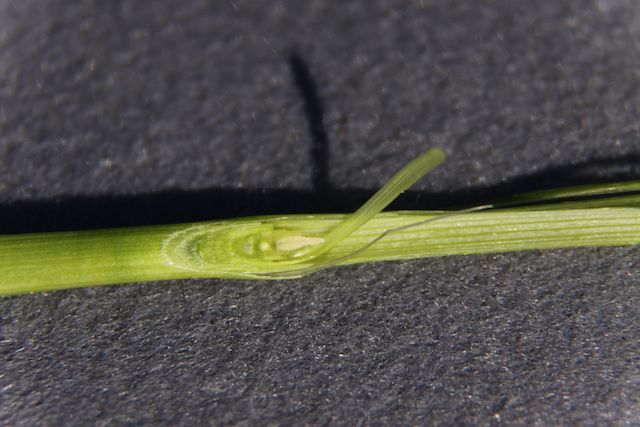
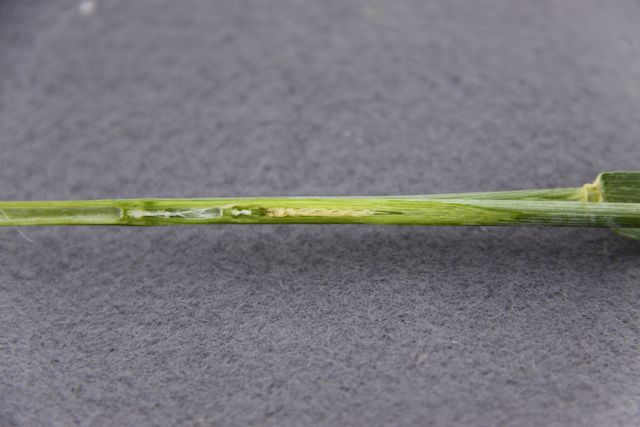
  • If there is 1.5 cm of hollow stem present (see picture below), it is time to remove cattle. 1.5 cm is about the same as the diameter of a dime.
  • Detailed information on first hollow stem can be found at www.wheat.okstate.edu under ‘wheat management’ then ‘grazing’
  • Image

Get to know the OSU Wheat Variety Testing Program

It occurred to me the other day that although I have publicized the forage, grain, and quality results from the OSU Wheat Variety Testing Program, I have never really given much effort to publicizing the day to day activities required to produce these results. So, over the next year I hope to write a few blogs to provide a little more insight into the workings of the system.

Location, location, location
Our program will have replicated trials at 23 sites in 2013/2014. These sites cover the state from Afton to Altus and McLoud to Keyes and some sites (e.g. Apache, Lahoma, Chickasha, Goodwell) have multiple trials. The location of trials are decided upon by throwing darts at a map (just kidding). We pick trial locations according to many factors including: visibility, uniformity, production history, local support, and cooperator involvement. Some locations (e.g. Lamont) have been in the system from the start, and others (e.g. McLoud) are fairly new additions. Given the miles between locations and a finite number of planting and harvest days, 23 locations is about the maximum we can handle and still complete operations in a timely fashion.

In addition to the small, replicated plots we organize and distribute ten-pound demonstration bags for County Educators. We typically have about 40 sets of 15 varieties for these ten pound “demo sets”.

OSU wheat variety testing locations cover Oklahoma from Afton to Altus and McLoud to Keyes. The Kingfisher location shown in this picture, also includes Dr. Carver's elite nursery of advanced experimental lines

OSU wheat variety testing locations cover Oklahoma from Afton to Altus and McLoud to Keyes. The Kingfisher location shown in this picture, also includes Dr. Carver’s elite nursery of advanced experimental lines

Who pays for all this?
The bulk of the expense of running the program comes in the form of salary, facilities, and miscellaneous overhead expenses and is largely covered by OSU through state appropriations (i.e. Oklahoma taxpayers). The bulk of the day to day operating expenses, such as seed, fuel, and mileage expenses, are covered through grants from the Oklahoma Wheat Commission and Oklahoma Wheat Research Foundation (i.e. Oklahoma wheat farmers). These two organizations also help with large equipment purchases such as tractors and combines. A relatively new area of support for the program is an entry fee system. The $500 per variety fee helps offset increasing expenses and is generally enough to assist with student labor for the project. We typically employ one or two graduate students and one or two undergraduate workers. Yes, we charge licensees for testing released OSU varieties but do not charge for OSU experimental lines.

Little packets of seed
Once we have determined which varieties will go at each location, we will send seed requests to participating companies. If everything goes well, we will receive seed in late August. We request one bag of most varieties and eight bags of varieties that will be included in the county demonstration packets.

Depending on the location, there are 25 to 45 varieties replicated four to eight times at each site. Each one of these plots starts with an envelope with either 60 (grain only) or 120 (dual purpose) grams of seed (120 grams is approximately 1/4 pound). This creates a total of about 4,000 envelopes that are weighed and packaged by hand each year. Envelopes are sorted according to a plot plan which randomly assigns varieties to locations within the field at each site. The plots plans are all created one at a time in Excel.

Planting five feet at a time
We have two planters. Our conventional planter sows eight six-inch rows and our no-till planter sows seven 7.5-inch rows. Seed is dropped into the distribution cone and released in the five foot alley between replications/blocks. A gear box is used to adjust the length of row over which the seed will be distributed. We work the ground with a small field cultivator at some locations and the producer or station manager works the ground for us at others.

Robert Calhoun and Matt Knori sow the 2013/2014 wheat variety test plots at Alva, OK. Robert is dropping a 60 gram envelope of seed into the cone that will evenly distribute the seed across eight six-inch rows over a distance of 25 ft. The red boxes on the back are for 18-46-0 (DAP). We apply 50 lbs of DAP in furrow at all locations. Photo courtesy Woods County Educator Greg Highfill

Robert Calhoun and Matt Knori sow the 2013/2014 wheat variety test plots at Alva, OK. Robert is dropping a 60 gram envelope of seed into the cone that will evenly distribute the seed across eight six-inch rows over a distance of 25 ft.
The red boxes on the back are for 18-46-0 (DAP). We apply 50 lbs of DAP in furrow at all locations.
Photo courtesy Woods County Educator Greg Highfill


2013 Wheat variety performance test results posted

All Oklahoma wheat variety test sites are now harvested and the results are posted at www.wheat.okstate.edu. I have posted a brief summary of the 2013 crop below. Over the next several weeks, I will be posting additional trial results on this blog along with opinion and analysis of results.


2013 WHEAT CROP OVERVIEW

At the time of writing this report, 2013 Oklahoma wheat production is estimated to be approximately 114 million bushels, which is roughly 26% less than 2012 production (Table 1).  The production decrease was due to the combination of lower yields and fewer harvested acres. Given the challenges faced in the 2012-2013 wheat production year, however, most would consider the average yield and total production to be much better than expected.


Table 1. Oklahoma wheat production for 2012 and 2013 as estimated by OK NASS, June 2013
 

2012

2013

Harvested Acres

4.3 million

3.8 million

Yield (bu/ac)

36

30

Total bushels

154.8 million

114 million


We have had several dry starts for wheat planting in Oklahoma, but the fall of 2012 might go down as the driest of the dry. A few timely rains in late August and early September allowed early and mid-September sown wheat to emerge and get a rapid start on forage production. This was the last substantial rain that most of western Oklahoma received until early 2013. As a result, much of our October-sown crop remained partially emerged in dry soil until after the first of the year.


Wheat that had emerged in September had consumed available water by early November and turned brown by December. Many fields were assumed dead, as there was no green tissue remaining above the soil surface (e.g. Marshall Dual-Purpose trial). This left little to no grazing potential for many dual-purpose wheat producers. Our Stillwater forage trial, for example, had less than 500 lb/ac (estimated) of available forage in early December, which is our normal forage measurement timing.


Rain was not plentiful in early 2013, but there was enough to allow the wheat crop to rebound. Wheat seed that had been lying in the soil germinated and early-emerging fields that had turned brown from drought were resuscitated and brought back to life. Wheat in southwestern OK and the Panhandle remained on life support throughout the season, surviving but never really thriving. Given these extreme circumstances, the grain yield at our Chattanooga, Altus, and Hooker sites are nothing short of amazing. Although wheat finally emerged at our Alva, Balko, Buffalo, Cherokee, Gage, Keyes, and Lamont sites, the stands were far too variable for use in comparing the yield potential of wheat varieties.


Drought was not the only weather-related issue Oklahoma wheat producers dealt with in 2013. There were multiple rounds of freeze events in late March and early April. Wheat in southwest Oklahoma and the Panhandle was affected by different freeze events but both sustained 30 to 80% tiller loss and were largely written off in the weeks following the freezes. Outside of far southwestern OK, cooler than normal conditions and some replenishment of soil moisture allowed regeneration of tillers. This, along with extended grainfill duration, allowed many wheat fields to recover and produce greater than expected grain yields (e.g. Apache variety trial). The cooler than normal spring temperatures were beneficial for wheat grainfill, but also delayed harvest by about one month as compared to 2012 and about two weeks as compared to the long term average.


It was a fairly quiet year regarding foliar disease. Pockets of the state suffered from heavy powdery mildew infestation in March and April, and some wheat producers chose to split-apply fungicides to combat this disease. There were also areas affected by glume blotch, tan spot, and septoria, but there was not much leaf or stripe rust present.


Yellow and purple leaves were tell tale signs that a late spring flush of aphids had transmitted barley yellow dwarf virus to several Oklahoma wheat fields. Armyworms were present late in the season, but generally did not reach threshold levels prior to maturity and few fields were sprayed. Winter grain mites took advantage of slow-growing, drought-stressed wheat and were a frequently reported problem in southwest OK, but the wheat curl mite takes top billing among mite pests in 2013. The wheat curl mite transmits wheat streak mosaic and high plains viruses. These two diseases are fairly common in the Panhandle but do not typically affect wheat in central OK. In 2013 fields as far east as Kingfisher tested positive for wheat streak mosaic and several central OK fields were affected. Growers affected by wheat streak mosaic should take care to ensure that any volunteer wheat or corn is dead at least two weeks prior to planting to reduce the risk of this disease in 2013-2014.


Wheat better than expected at Chattanooga, Kingfisher, and Chickasha

Chattanooga, Kingfisher, and Chickasha wheat variety trial results are posted at www.wheat.okstate.edu.  Grain yields at Chattanooga ranged from 12 to 36 bushels per acre. It is truly amazing that wheat somehow managed to produce these yields this in the presence of severe drought and three major freezes. Kingfisher wheat grain yields ranged from 32 to 47 bushels per acre and were more or less on par with expectations. This site had less than ideal moisture conditions, but adequate moisture to keep the wheat from turning brown as it did in many locations.

The Chickasha wheat variety trial had some problems. A late March freeze killed up to 58% of viable tillers in some varieties and lodging at harvest was moderate to severe. While leaf rust and stripe rust were not major factors, we did have a variety of leaf spotting diseases (e.g. tan spot, septoria, glum blotch) and severe, widespread bacterial blight/black chaff throughout the plot. In spite of these challenges, average yield at this site was 69 bushels per acre with yields ranging from 50 to 83 bushels per acre. While these yields are outstanding given the challenges of the year, they are not the best at the Chickasha research station. Approximately 200 feet from the variety trial was a growth regulator study planted to Iba that produced 98 to 102 bushels per acre. I have this same trial at two additional locations and will summarize results later in the year.

Both small plot combines running at Chickasha

Both small plot combines running at Chickasha

Altus wheat variety trial results

It was a rough year to farm wheat in Altus, OK. Our plots were sown into extremely dry soil on October 8, 2012 and received a total of 1.08 inches of rain by December 31. Total rainfall for the entire season was only 7.9 inches. Under these conditions it is amazing that wheat survived, but we somehow entered March with approximately 30 bu/ac yield potential. Some production fields in the area had 50 bu/ac potential and needed nothing more than a few rains to maintain this yield potential. The rains never came and Mother Nature dealt an additional card from the bottom of the deck with major freeze events in late March, late April, and early May.

Altus wheat variety trial results are posted at www.wheat.okstate.edu. Top varieties this year were Doublestop CL Plus (25 bu/ac), WB-Grainfield (22bu/ac), and the OSU experimental lines OK08328 (23 bu/ac) and OK09125 (22 bu/ac). Eleven out of 39 varieties made less than 10 bu/ac, and it is hard to say if drought or freeze had the larger effect on wheat yield. Based on the maturity rating of the top yielding varieties (ie late maturing) one could make the argument that freeze had the larger effect, but some relatively early and medium maturing varieties performed relatively well in the presence of the freeze (e.g. Duster and OK Bullet). The interactions are complicated and not easily explained.

Additional variety trial results will be posted as locations are harvested. To keep up with the latest results, follow me on Twitter @OSU_smallgrains


Freeze injury update – worse than we thought

On April 4th I toured southwest Oklahoma and surveyed freeze injury to wheat. In my experience, most freeze events are overhyped; however, this one was the real deal Holyfield.  I traveled a route from Faxon to Chattanooga to Altus to Blair and ended up at Apache. Damage was similar at all sites, with injury ranging from 50 to 80%.

The best looking wheat was the hardest hit. Particularly troubling are some fields in the Altus area that easily had 80 bushel potential prior to the freeze. In most of these fields we are too far past the tillering stage to have yield compensation from secondary tillers. Late-emerging fields that were jointing or smaller escaped the freeze with little injury. Fields that had been heavily grazed and/or under-fertilized also escaped with relatively minor injury.  Conditions improved slightly when I checked wheat in the Chickasha area and injury was more in the 10 – 30% range.

I am frequently asked if the injured wheat head will go ahead and “push through” as the season progresses, and the answer is no. So, if you see heads emerging out of the boot in a few weeks, they are likely not damaged and a head count at this stage will be a reasonable estimate of fertile heads. Since there will not be additional stem elongation in freeze injured wheat, it will not accumulate as much tonnage as in a ‘normal’ year.

I have posted a few pictures below showing freeze injury symptoms. Freeze injury can vary greatly among fields and even within a field. So, it is important to check several sites within a field and split several stems when determining the percent injury. Check early maturing varieties such as Jackpot, Billings, and Everest first, as they are most likely to have injury.

Image

Endurance wheat collected from plots at Chattanooga, OK. The two top heads are freeze damaged and will not recover. Note the shriveled, white appearance of the wheat head. The bottom head was not injured and is healthy green.

A healthy head of Endurance  from Apache, OK.

A healthy head of Endurance from Apache, OK.

Even though this wheat was just past jointing, it was injured by the freeze and the head was lost.

Even though this wheat was just past jointing, it was injured by the freeze and the head was lost.

Freeze injured Billings from the Altus research station

Freeze injured Billings from the Altus research station

A sign of the drought. Wheat seed still easy to find on a sample from near Altus, OK April 4.

A sign of the drought. Wheat seed still easy to find on a sample from near Altus, OK April 4.

First hollow stem update 03/08/2013

We are not progressing towards first hollow stem as quickly as I anticipated, but most varieties are getting close. The drought has likely slowed onset of first hollow stem. Keep in mind that drought stressed wheat might need longer to recover from grazing, so it will likely be better to remove cattle a little early in 2013.

CHICKASHA

                 cm of hollow stem

Variety           03/06/13

Jagger             .

Endurance       0.46

Deliver             0.43

Pete                 0.4

Ruby Lee         1.3

Garrison           1.44

Duster              0.49

Gallagher        .

Iba                   0.78

Fuller               1.99

Everest           .

Jackpot            1.69

Doans              0.55

Greer               .

CJ                    0.38

Razor               .

Armour             1.7

WB-Cedar        0.82

WB-Redhawk    2.71

T153                2.27

T154                2.44

T158                0.5

OK08328         0.36

*Average of ten hollow stem measurements in wheat sown 09/20/12 at Chickasha, OK

Stillwater

                 cm of hollow stem

Variety            03/05/13

Jagger                 1.1

Endurance          0.2

Deliver                 0.7

Pete                    0.3

OK Bullet            0.5

OK Rising            0.7

Centerfield          0.3

Ruby Lee             2.4

Garrison               1.6

Duster                  .

Gallgher              0.7

Iba                       0.1

Billings                0.4

Fuller                   1.8

Everest                .

Jackpot                1.5

Doans                  1.7

Greer                   0.5

CJ                        0.2

Razor                   2.8

Armour                1.2

WB-Cedar            1.1

WB-Redhawk       0.9

WB-Duece CL+    .

WB-Grainfield      0.7

Winterhawk          1.2

WB-4458             .

T153                   1.7

T154                   2.0

T158                   0.1

LCS Mint             0.1

LCH08-80            0.1

LCH08 – 109        0.3

T173                   0.4

Byrd                     0.1

Brawl CL+            0.1

TAM 113             0.4

OK09915C          0.4

OK09935C          0.4

OK09634             0.5

OK09125             0.4

OK09528             0.2

OK09729             0.4

OK08328             0.1

*Average of ten hollow stem measurements in wheat sown 09/18/12 at Stillwater, OK


Onset of first hollow stem was affected by severe drought stress

First hollow stem update – 03/01/2013

The OSU Small Grains Extension team checked first hollow stem at Chickasha and Stillwater this week. Measurements from both locations are provided in the tables below. Varieties with 1.5 cm or more of hollow stem are considered to be at first hollow stem. Numbers have not changed much at Chickasha due to the cold weather; however, with temperatures climbing into the 60’s next week we should see rapid progression of first hollow stem. Although planted a few days earlier, Stillwater is about a week behind Chickasha in terms of first hollow stem. This is due to severe drought stress at Stillwater. In fact, there were a few times I questioned wether or not the Stillwater plots would survive. In this situation it is important to not only consider first hollow stem but also the amount of green leaf area remaining after grazing. Wheat with less than 60% ground cover at jointing will likely not achieve full grain yield potential, even if cattle were removed prior to first hollow stem.

CHICKASHA

                     cm of hollow stem

Variety               02/28/13

Jagger                   2.5

Endurance             0.1

Deliver                   0.3

Pete                       0.2

Ruby Lee               1.1

Garrison                 0.8

Duster                    0.5

Gallagher             

Iba                         0.4

Fuller                     1.5

Everest                 –

Jackpot                  0.7

Doans                    0.4

Greer                     1.6

CJ                          0.8

Razor                     4.0

Armour                   1.0

WB-Cedar              1.1

WB-Redhawk          1.1

T153                      1.2

T154                      1.0

T158                      0.3

OK08328               0.4

*Average of ten hollow stem measurements in wheat sown 09/20/12 at Chickasha, OK


Stillwater


                     cm of hollow stem

Variety               02/27/13

Jagger                     0.4

Endurance              0.1

Deliver                     0.7

Pete                        0.3

OK Bullet                0.1

OK Rising                0.4

Centerfield              0.3

Ruby Lee                 1.2

Garrison                   0.5

Duster                      0.0

Gallgher                  0.3

Iba                           0.0

Billings                    0.2

Fuller                       0.5

Everest                    2.3

Jackpot                    0.8

Doans                      0.5

Greer                       0.4

CJ                            0.0

Razor                       0.6

Armour                    0.1

WB-Cedar                0.6

WB-Redhawk           0.9

WB-Duece CL+        4.2

WB-Grainfield          0.4

Winterhawk              0.6

WB-4458                 1.6

T153                       0.9

T154                       0.7

T158                       0.1

LCS Mint                 0.1

LCH08-80                0.0

LCH08 – 109            0.2

T173                       0.0

Byrd                         0.2

Brawl CL+                0.2

TAM 113                 0.3

OK09915C              0.1

OK09935C              0.1

OK09634                 0.0

OK09125                 0.1

OK09528                 0.0

OK09729                 0.2

OK08328                 0.1

*Average of ten hollow stem measurements in wheat sown 09/18/12 at Stillwater, OK


Onset of first hollow stem was affected by severe drought stress

How dry is it?

It was too nice of a day to stay in the office yesterday, so I checked on our wheat variety plots. I started at McLoud, moved west to Kingfisher, and ended up at Marshall. As indicated by the pictures and captions below, neither the wheat nor my mood improved as I traveled west. I am sure if I had traveled farther west, this would have gotten worse. The bottom line is that we are in desperate need of moisture in Oklahoma. Early-sown wheat is backpedaling quickly and cannot hold on too much longer. Much of the later sown wheat has yet to emerge. We are certainly not on our way to a record year, but everything could still turn out okay……..if it rains.